Jev Explained: The System One Model Built for Fast, Typed Decisions

Jev Explained: The System One Model Built for Fast, Typed Decisions
Large language models were primarily designed around one interface: generate text for a human.
That interface works remarkably well for chat, writing, coding, and reasoning. But it becomes awkward when the consumer of the model is not a human.
Software does not really want a paragraph saying:
"I think this support ticket is probably related to billing, although there is a small possibility that it could be technical."
Software wants something closer to:
department = "billing"
probability = 0.94
That distinction is the basic idea behind Jev, TypeSafe AI's first publicly released System One model.
TypeSafe describes Jev as a model that accepts an application state and typed questions, then returns structured values and probabilities that software can consume directly. It does not generate ordinary text responses.
What is Jev?
Jev is the first public model from TypeSafe AI's System One model family.
TypeSafe's central argument is that many production AI systems do not need another chatbot. They need a model that can repeatedly make small, well-defined judgments inside software.
The company describes the interface as:
unstructured state
        ↓
typed probabilistic decisions
rather than:
prompt
  ↓
generated text
That changes almost everything about the inference problem.
A conventional LLM might answer:
"The customer appears to be asking for a refund,
so this should probably go to the billing department."
Jev instead works with predefined decision spaces such as:
Choice:
billing
technical
other
and can return a probability distribution over those possibilities.
TypeSafe currently exposes three main primitives:
Choice
Score
Noul
Choice selects an option from a predefined set.
Score evaluates something against an ordered rubric.
Noul evaluates whether a statement is true and returns a value between 0 and 1.
The basic architecture
The exact internal neural architecture of Jev has not been publicly disclosed in the same level of detail as an open-weight research model.
TypeSafe does disclose three important architectural properties:
- Jev is a new model architecture designed specifically for System One decisions.
- It uses a parallel sampler.
- It is trained with Reinforcement Learning for Calibrated Decisions (RLCD).
So it would be misleading to draw a conventional Transformer diagram and claim that it represents Jev's internal architecture.
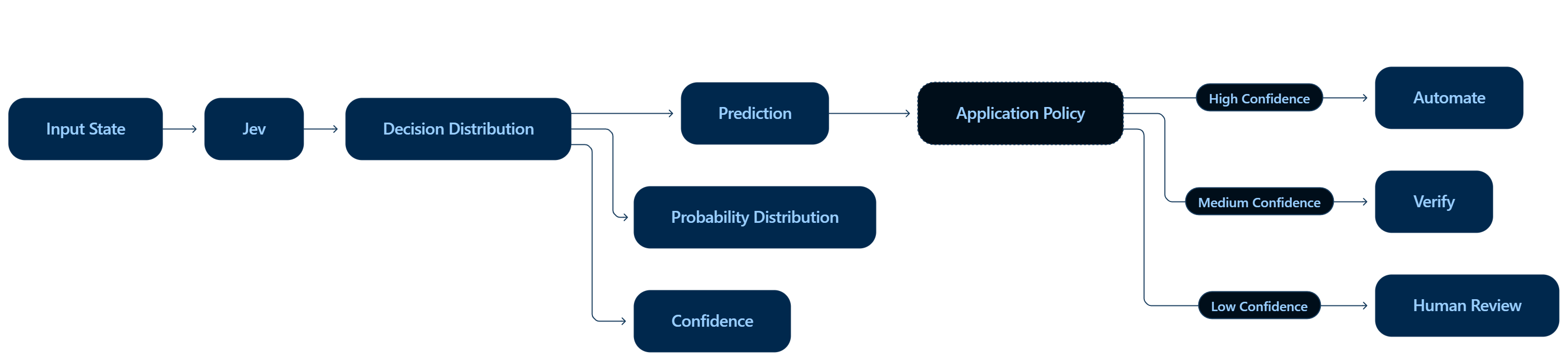
What we can accurately describe is the observable architecture of the system:
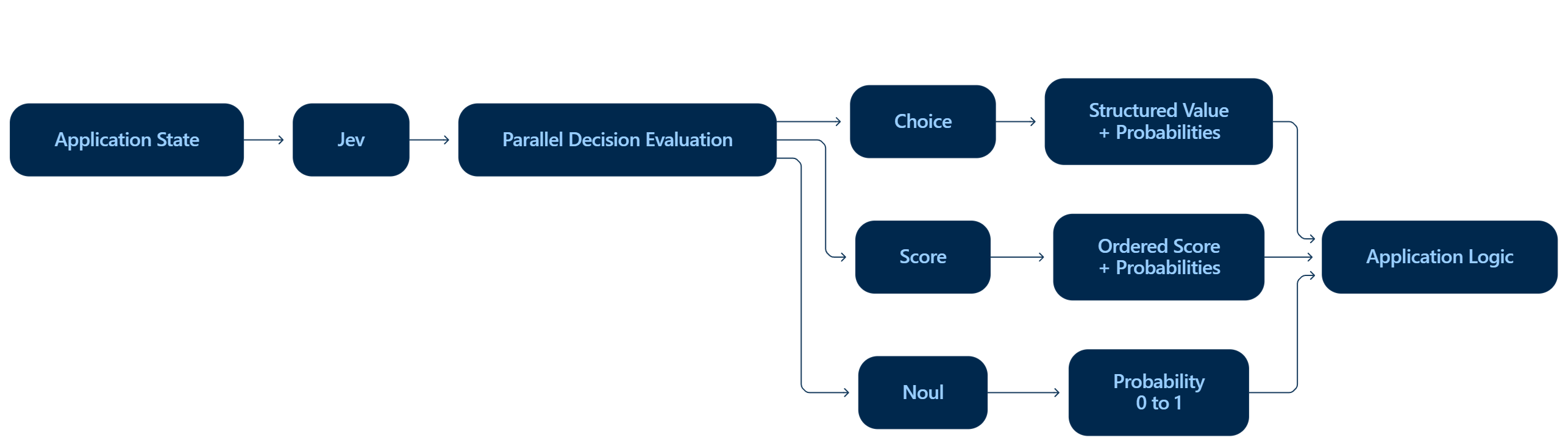
The crucial point is that Jev isn't generating a token sequence and then asking another program to parse that sequence.
The output type is part of the model interaction itself.
What does "typed" mean?
Suppose we want to route customer tickets.
A normal LLM might generate:
This appears to be a billing issue.
Your application would then have to somehow turn that into:
department = "billing"
That conversion introduces another failure surface.
Jev instead receives the allowed options as part of the decision definition.
Conceptually:
Choice(
    billing
    technical
    other
)
The model can only return one of those choices.
This is what TypeSafe calls type safety.
The model cannot suddenly invent:
"customer_success_and_billing"
when that isn't one of the allowed options.
TypeSafe emphasizes that every answer is constrained to the options or levels supplied by the caller.
That is an important distinction from the stronger and potentially misleading statement that the model "cannot be wrong."
It can absolutely make an incorrect decision.
What it cannot do is produce a value outside the specified output space.
The three Jev primitives
1. Choice
Use Choice when the answer must be selected from known alternatives.
Example:
Which department should handle this ticket?

billing
technical
sales
other
A response can conceptually look like:
choice = billing

probabilities:
billing   = 0.94
technical = 0.05
sales     = 0.01
other     = 0.00
The probabilities are important because the application doesn't have to treat every decision as binary certainty.
TypeSafe explicitly recommends adding an other or none of the above option when the predefined list may not cover every possible input.
2. Score
Score is used for ordered concepts.
For example:
How severe is this bug?

1 = minor
2 = moderate
3 = serious
4 = critical
The important difference from Choice is that the levels have an order.
A model could return a score distribution indicating that the input lies mainly between levels 2 and 3.
TypeSafe notes that the returned score can lie between explicitly defined levels, while the underlying probability distribution covers those levels.
3. Noul
Noul is essentially a probabilistic truth judgment.
Example:
Does the customer explicitly request a refund?
The output is:
0.91
which represents the model's probability that the statement is true.
TypeSafe describes values close to 1 as strong yes, values close to 0 as strong no, and approximately 0.5 as uncertainty.
The most interesting part: parallel evaluation
This is one of the fundamental differences between Jev and a standard autoregressive LLM.
A normal language model generates:
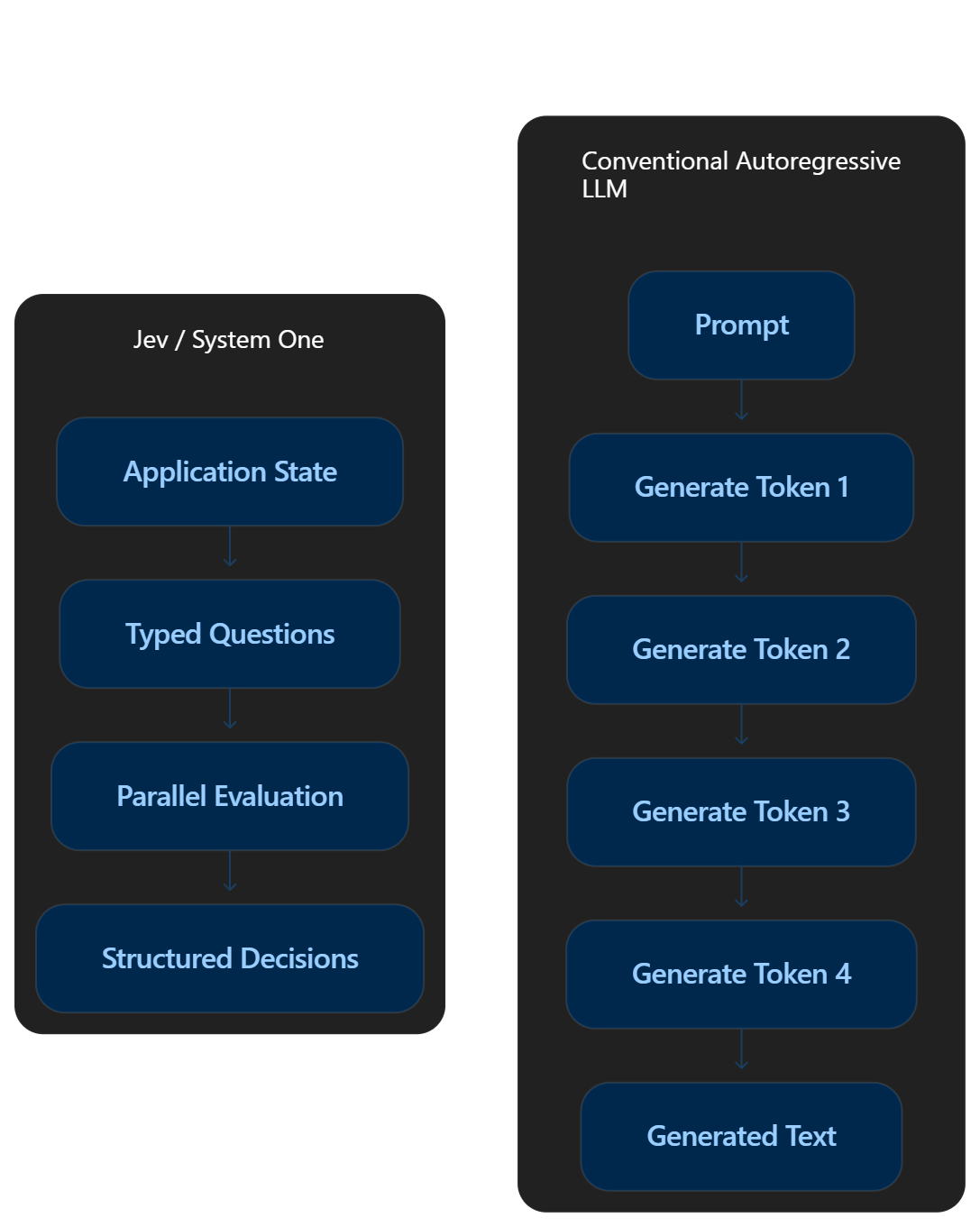
Each new token depends on the previous generated sequence.
Jev instead evaluates multiple typed questions against the same state in parallel.
For example:
State:
Customer says they were charged twice.

Question 1:
Which department?

Question 2:
Is a refund explicitly requested?

Question 3:
How frustrated is the customer?

Question 4:
How urgent is the issue?
Conceptually:
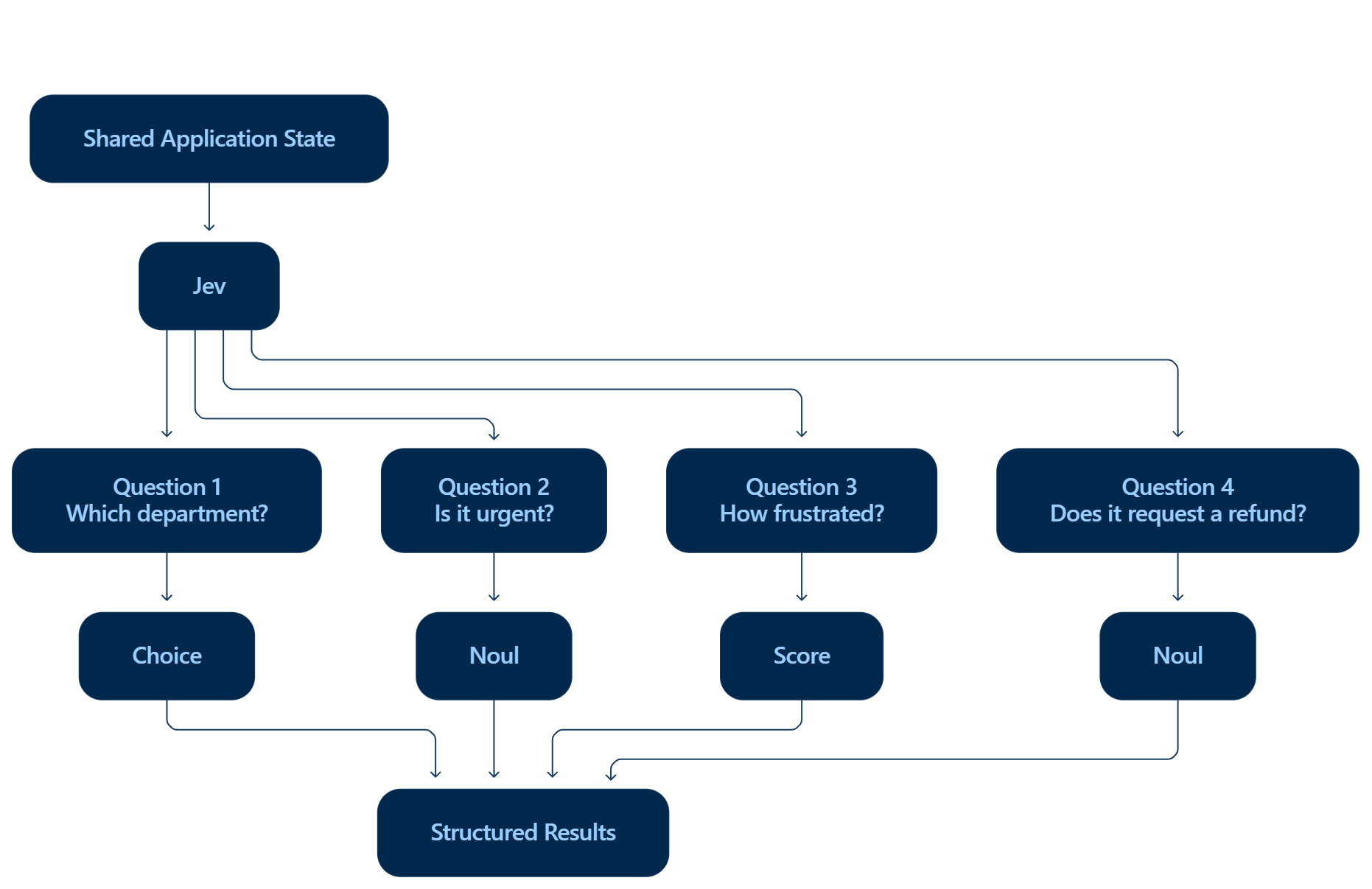
TypeSafe's documentation states that questions in the same request are evaluated independently and in parallel against the same state. Adding questions therefore has little effect on response time compared with making separate requests.
This is important because the model is optimized around decisions rather than generated sequences.
Why does parallelism matter?
Consider a model that needs to answer ten independent questions.
A conventional application might make:
request 1
request 2
request 3
...
request 10
Jev can batch the questions into one System One request.
The model evaluates those questions against the same state.
TypeSafe calls this the speculative fan-out pattern. Its documentation reports an example where batching 13 questions in one request was substantially faster and cheaper than making 13 separate calls. That number is a TypeSafe cookbook measurement, not a universal guarantee for every workload.
RLCD: Reinforcement Learning for Calibrated Decisions
The other major component is the training objective.
Traditional instruction-tuned LLMs are optimized toward generating useful responses, with methods such as RLHF or RLVR appearing at different stages of modern LLM development.
TypeSafe proposes another target:
RLCD — Reinforcement Learning for Calibrated Decisions.
The idea is not merely to answer correctly.
It is to produce a probability distribution whose confidence corresponds meaningfully to actual reliability.
For example, suppose a classifier is right 95% of the time.
A poorly calibrated model may output:
confidence = 0.999
on almost everything.
A calibrated model should place greater probability mass on uncertain cases and reserve high confidence for cases where it has historically demonstrated high reliability.
TypeSafe explicitly describes RLCD as training for decisions and calibrated probabilities rather than generated text.
Probability versus confidence
These two concepts are easy to mix up.
Suppose Jev produces:
billing   0.92
technical 0.06
other     0.02
The probability distribution provides the full information.
TypeSafe also returns a confidence value for Choice and Score. It describes confidence as a statistic derived from the distribution.
This allows an application to do something much more interesting than:
if prediction == "billing":
    send_to_billing()
It can instead implement:
High confidence
    ↓
automate

Medium confidence
    ↓
verify or ask for confirmation

Low confidence
    ↓
human review / fallback
TypeSafe specifically recommends risk-dependent thresholds rather than one universal confidence threshold.
Example: building an AI routing system
Suppose we have this ticket:
"I was charged twice and need the duplicate payment refunded today."
We can ask three independent questions:
1. What is the customer's request?
2. Is the request urgent?
3. How frustrated is the customer?
The Python SDK makes this relatively compact.
"""Demonstrate a multi-question Jev System One workflow for customer-ticket routing."""

from typesafe_sdk import Choice, Noul, Score, TypeSafeClient


def main() -> None:
    state = {
        "ticket": (
            "I was charged twice and need the duplicate payment "
            "refunded today."
        )
    }

    with TypeSafeClient() as client:
        response = client.system_one(
            state=state,
            questions={
                "request_type": Choice(
                    instructions="What is the customer's main request?",
                    criteria={
                        "refund": "The customer wants money returned.",
                        "technical": "The customer needs technical assistance.",
                        "information": "The customer is requesting information.",
                        "other": "None of the listed categories clearly apply.",
                    },
                ),
                "urgent": Noul(
                    instructions="Does the customer explicitly communicate time pressure?"
                ),
                "frustration": Score(
                    instructions="How frustrated does the customer appear?",
                    criteria=[
                        "Calm and neutral",
                        "Concerned but civil",
                        "Very frustrated or using strong language",
                    ],
                ),
            },
        )

    request_type = response.answers["request_type"]
    urgent = response.answers["urgent"]
    frustration = response.answers["frustration"]

    print(request_type.choice)
    print(request_type.probabilities)
    print(request_type.confidence)
    print(urgent.noul)
    print(frustration.score)


if __name__ == "__main__":
    main()
The SDK supports Python and TypeScript/JavaScript interfaces, and the current official Python package is typesafe-sdk.
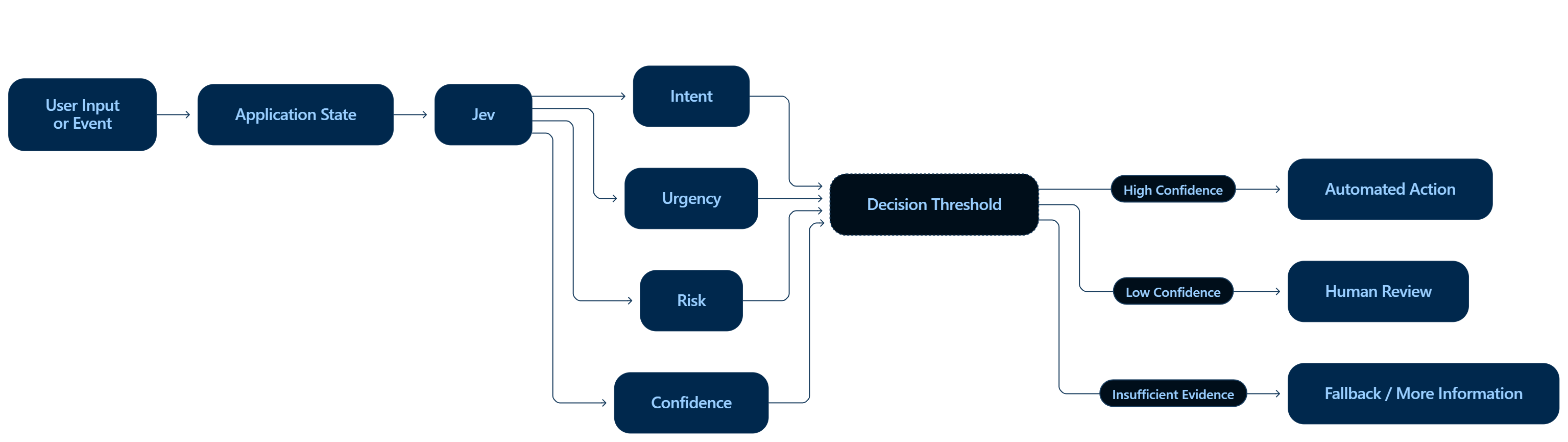
How Jev fits into an actual software system
The model becomes most interesting when its output is combined with normal deterministic code.
Consider:
The model handles fuzzy semantic judgments.
The program handles the deterministic consequences.
That separation is central to TypeSafe's System One philosophy.
Is Jev just a smaller LLM?
Not according to TypeSafe's intended design.
The important distinction is not parameter count.
It is the objective and interface.
A generative LLM is optimized around:
generate the next token
Jev is optimized around:
evaluate a structured judgment
That means the two systems can have very different efficiency characteristics even when they have comparable underlying intelligence on a particular task.
TypeSafe reports 70–500 ms end-to-end response times for its System One API and claims that Jev can reach roughly 40×–200× lower latency than frontier LLMs on its System One-shaped evaluations. These are vendor-reported measurements, and TypeSafe itself notes that the exact gains depend strongly on workload.
Where Jev is useful
Jev is especially interesting for tasks such as:
classification
routing
scoring
ranking
moderation
guardrails
verification
tool selection
fraud screening
human-review routing
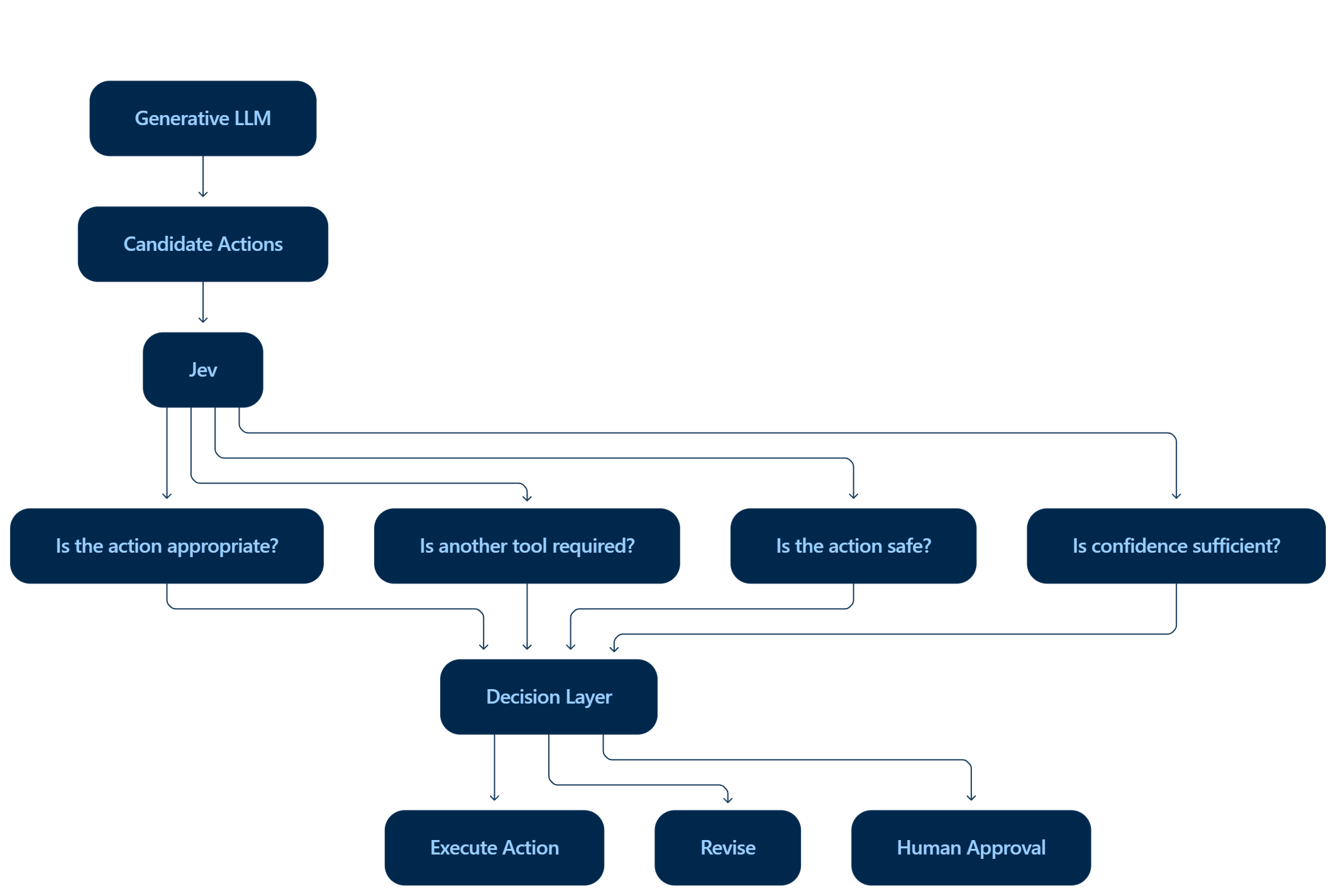
It can also be used inside larger agents.
For example:
LLM
 │
 ├── generates candidate solution
 │
 ▼
Jev
 │
 ├── Is this safe?
 ├── Is this relevant?
 ├── Is another tool necessary?
 └── Is confidence sufficient?
That makes System One models complementary to generative LLMs rather than necessarily replacements for them.
What Jev cannot do
This is perhaps the most important part of understanding it correctly.
Jev intentionally gives up ordinary string generation.
TypeSafe explicitly says that Jev is optimized for structured outputs rather than generated text.
So Jev is not the model you would use to:
write a 3,000-word article
write a Python program
write a novel
generate an email
produce a research paper
Instead, a very plausible architecture is:
                   LLM
                    │
              generated content
                    │
                    ▼
                  JE V
                    │
          structured judgments
                    │
             ┌──────┴──────┐
             ▼             ▼
          accept          revise
The "zero hallucination" claim needs nuance
TypeSafe uses strong language around hallucination and says Jev cannot produce type errors because its output space is predefined.
The technically useful distinction is:
Type error:
"I think the answer is purple-elephant."

Decision error:
"I selected billing, but technical was actually correct."
The first can be prevented structurally.
The second cannot simply be eliminated by typing.
Therefore:
Jev's structured interface can eliminate a class of hallucination involving invalid outputs, but it does not make the underlying semantic decision infallible.
The probability and confidence outputs are intended to give the surrounding application a mechanism for handling uncertainty rather than pretending every prediction is certain.
A useful mental model
The easiest way to understand Jev is:
Traditional LLM

    "What should I write?"
              ↓
          tokens
              ↓
            text


Jev

    "What decision should software make?"
              ↓
       typed probability
              ↓
        application logic
That is the fundamental shift.
Jev is less like an AI writer and more like an intelligence primitive inside a program.
Final assessment
Jev is interesting not because it is "a faster chatbot."
It represents a different design philosophy:
AI does not always need to generate language. Sometimes it only needs to make a well-defined judgment.
The architecture TypeSafe has publicly described is built around that assumption: structured decision primitives, parallel evaluation, calibrated probabilities, and deterministic software composition. The exact neural architecture remains proprietary, so claims about individual internal layers should be treated as unknown rather than inferred from the API.
That separation between reasoning/decision and language generation is arguably the most interesting part of Jev.
It also raises a much bigger research question:
How much of what we currently make LLMs generate could instead be represented as persistent state, typed decisions, or latent computation?
That is where models like Jev become especially relevant to the next generation of AI agents.